Tuesday, August 3, 2010

 Pour lire en français, cliquez ici

We chose to arrive in Lhasa by travelling on the world’s highest railway, a journey of breath-taking beauty that lasts 24 hours from the Chinese city of Xining, and crosses the Tanggula Pass at 5072m. Arriving late at night, we were greeted by our guide in Lhasa with khatags, the white silk ceremonial scarf that is commonly given in Tibet as a sign of welcome. This was the first of many khatags we received.

Tibetan Landscape

Lhasa literally means "The abode of the gods" and hosts three very important religious sites : the Barkhor, the Potala Palace, and the Jokhang Temple. The latter is the spiritual centre of Lhasa, and is the largest temple of Tibetan Buddhism. Visiting the Jokhang is an unforgettable experience. Outside the temple are pilgrims performing thousands of ritual prostrations, some of whom have travelled hundreds of miles this way. Many wear leather aprons and kneepads fashioned from tires, and hold pieces of wood to help them slide more easily without injuring themselves, but it’s easy to recognise those who have come far by the marks on their forehead (it’s estimated that it takes about 70 000 successive prostrations to travel one hundred kilometres !). Inside the temple the acrid scent of yak butter lamps pervades the air with a distinctive rancid smell, very characteristic of Tibetan temples. The walls are blackened by centuries of lamp smoke, but it’s still possible to distinguish the striking paintings of bulging-eyed "wrathful deities" wearing garlands of severed heads. In the temple, which you have to move round clockwise, our companions were mainly small old ladies who walk while constantly turning a small handheld prayer wheel. In the street you frequently see Tibetans of all ages walking while turning a prayer wheel in one hand and holding a child or a bag of shopping in the other. They contain written mantras (prayers), and turning them supposedly releases the prayer into the air just as if it was being spoken.

Potala Palace from the Jokhang Temple

The Jokhang is surrounded by the Barkhor, a fascinating maze of narrow streets, and the most popular circumambulation with Buddhist pilgrims and inhabitants of Lhasa. A little further is the famous Potala Palace: the primary residence of successive Dalai Lamas until 1959. Composed of the white palace that was once the residence of the Dalai Lama, and the Red Palace, which was entirely devoted to religious study and prayer, it has 1000 rooms and houses 200 000 Buddhist images.


We left Lhasa after several days having acclimatised to the altitude (but not to the yak butter tea), and headed towards the base camp of Mount Everest, stopping in Shigatse and Xegar for more acclimatisation and sightseeing. En route we saw many yaks, and stocks of dried yak-dung (which is used as fuel), and we stopped at several passes of 5000m or more, generally adorned with colourful prayer flags fluttering in the wind. At one pass it was snowing – at the beginning of August ! At the base camp we were fortunate to have blue skies and only a few clouds, and so had a relatively good view of Qomolangma ("Goddess Mother of the Winds") as it’s known in Tibetan.

Mount Everest from the base camp

Just after leaving the base camp we were lucky enough to have a private visit of the Nyingma Rongphu Monastery, the highest monastery in the world (altitude : 5100m), which is cut off from the outside world from December to March.

Rongphu monastery

Isolated and windswept, it seems to receive few visitors, and was guarded by a ferocious-looking Tibetan mastiff. The towering peaks were surrounded by birds of prey that reminded us of the existence - ever present - of the Tibetan custom of sky burial. Practiced for over a thousand years this form of burial is the preferred choice of most Tibetans: the corpse is prepared by a specially trained monk and then left to the "holy birds". During the 1970s and 80s the custom was prohibited by the Chinese who regarded it as barbaric, however it has since been restored as it makes perfect sense in a land with few trees and little topsoil. For the Tibetans the dead body is nothing, only the spirit matters and it leaves the body at death.

Circle of Life of Tibetan Buddhism

If you enjoyed this post you might also like:

Suggested reading :
  • The Tibetan uprising - BBC Radio 4 programme about the shortlived battle for independence in 1959 against Chinese occupying forces.

Saturday, July 31, 2010


These people work for free, AND they sing while they work !

We filmed this at
Jokhang temple, Lhasa, Tibet.


If you enjoyed this post you might also like:


Thursday, July 29, 2010

The Tibetan railway is the world's highest, and was opened in 2006.  It's officially called the Qingzang railway. Trains run to Lhasa from Beijing, Chengdu, Chongqing, Guangzhou, Lanzhou and Xining. We took the train from Xining:

Xining to Lhasa destination board on our train

Carriages are specially equipped for high altitude travel, and include oxygen outlets. Although we'd already some experience of interesting train journeys (eg the Trans-Siberian), this journey, while not so long - only 24 hours from Xining to Lhasa - travels through some spectacular scenery. 


Although we were travelling during summer there were plenty of snow-capped mountains. 


There were few signs of life apart from some birds, animals, or occasional traffic using the road which runs alongside the train tracks for part of the distance.

cycling to Tibet
Tibetan wild asses
The highest point on the railway is the Tanggula pass at 5072m. While I didn't manage to get a photo of the station as the train doesn't stop there, I managed to snap this station at 4513m.


After the pass the train heads down to Lhasa which is 'only' at 3600m above sea level.


Lhasa station seen from Ganden monastery

The railway is somewhat controversial as Tibetan independence groups have seen the railway as a further sign of Chinese dominance over Tibet.  It makes it easier for Han Chinese workers and tourists to travel to Tibet, and for the government to send dissidents and mineral resources out of the province.

Some facts:
  • Tangula Pass is the world's highest station and highest railway track
  • The Mount Fenghuo rail tunnel is the world's highest at 4905m
  • There are 675 bridges
  • 550km of the railway is laid on permafrost
  • 33 overpasses were constructed specifically to allow continued animal migration
  • 960km of the railway are at more than 4000m altitude.
    If you enjoyed this post you might also like:


    Sunday, July 11, 2010


      Pour lire cet article en français cliquez ici


    Crouching as low as possible under a shared del[1] the three of us waited for the lightning storm to pass. We were in the middle of the Mongolian steppe, with no shelter for miles around – no trees, no high ground, nothing:


    We were dressed in T-shirts and still sporting sunglasses and sun cream when the storm had arrived unexpectedly. Nearby we could hear the noises made by our animals – camels, horses and dogs. By squatting in the 'lightning crouch' with our heels touching we could hopefully reduce the risk if a bolt struck nearby, but the 25 minutes we spent in that position, being pelted at by hail, seemed to last forever !

    Thus passed part of our first day on a ten-day ger-to-ger[2] expedition. We had signed up with a nomad-centred cultural eco-tourism association in order to experience the 'real' Mongolia, and we were certainly not disappointed. While the families we stayed with did not change location while we lodged with them.

    typical family

    We moved every day to a home-stay (or rather 'ger-stay') with a different family, migrating by horseback, camelback :


    ox-cart :


    or four-wheel drive :


    no, there wasn't a road !


    during a breakdown !

    We were fully able to appreciate the advantages, difficulties and drawbacks of the nomad lifestyle, and overall we were enchanted. (Drawbacks include such delights as bed-bugs, no water for washing, and a total lack of toilets/toilet privacy !)

    typical ger

    Before setting off on our adventures, we had attended a briefing in Ulaanbaatar.


    Ulaanbaatar

    where we learnt some useful Mongolian phrases (eg "I like galloping on the horse" or "I have never ridden a horse" – better to not mix them up), and how to play the anklebone game, along with the concept of Mongolian 'GPS' – Ger Positioning System. In a land with few permanent roads and even fewer road-signs, this means following the (vague) sweep of a ger owner's hand over the horizon to the next ger.

    We were also able to learn firsthand some other cultural "do's and don'ts" such as not treading on the ger threshold when you walk over it, that men should enter the ger first, and when sleeping always having your feet point towards the door, rather than the family altar. (By the way, the door of a ger always faces south, towards the sun).


    ger interior

    ger furniture

     
    ger roof


    The hot, salty - and surprisingly delicious - tea that Mongolians drink copious amounts of had to be sipped as soon as it was served, and any delicacy offered must be tasted out of politeness. This last point was not normally a problem for me, apart from one occasion on which we were presented with a hot steaming plate of freshly cooked goat offal from an animal we'd heard killed a few hours earlier !

    Lots of fresh air meant we had a good appetite and the food, while not very varied, was abundant and filling.


    On arrival in a ger we were generally offered some curds or cheese from a communal plate, and on some occasions ger-made vodka. One morning for breakfast we had the treat of some freshly made, incredibly creamy, finger-lickingly good butter.


    Meals were often cooked on a stove fuelled with horse-dung, and generally consisted of home made noodles mixed with beef/yak or mutton and maybe some vegetables, which would have been bought at the nearest village (nomads, by definition, do not grow veggies !). Refrigerators being non-existent, the meat was generally kept wrapped in an old cloth, and when needed a piece was broken off and beaten into submission with a hammer[3]. 

    Nomad women and men both work very hard. The women, along with general food preparation, had the responsibility of milking the animals twice a day and making a large variety of dairy products. Milk was never used all by itself, but always boiled beforehand. I tried both milking and butter churning and soon realised how easy the women made these difficult tasks look ! 'Necklaces' of cheese were often strung up inside the ger or left in trays on the roof outside to dry.


    Even something as simple as having drinking water meant fuelling the stove, boiling a large pan of water (water which had to be brought from the nearest village) which then had to be filtered through a piece of muslin into a thermos, and then one had to wait for the water to reach a drinkable temperature. The menfolk were generally involved in looking after the herds of animals:

     
    and spent much time on horseback.


    We too were often able to ride horses, though purely for pleasure ! It was wonderful to ride through the green picture-postcard-perfect landscapes, with wide open spaces stretching as far as the eye could see under clear blue skies. We quickly learnt the way of Mongolian horse-riding (long stirrups, short reins, no rising trot) and the Mongolian word for giddyup ('tchoo'). While riding we frequently saw large birds of prey :


    or groups of animals – it was difficult to distinguish between domesticated and wild.


    We also saw many ovoo, shamanistic collections of stones usually found in high places, on top of hills for example. They were easy to spot with their blue prayer flags blowing in the breeze.


    ovoo at Erdene Zuu monastery, Kharkhorin


    All too soon it was time to head back to Ulaanbaatar, appreciate our first shower in several days, and hop onto the Trans-Mongolian train for the next leg of our journey.

    Beijing to Ulaanbaatar

    Gobi Desert seen from Trans-Mongolian


    This article was originally published in SIWA's Discovery magazine (October-November 2010 issue).

    [1] traditional Mongolian knee-length gown with long sleeves.
    [2] 'ger' is the Mongolian word for 'yurt' – the portable, round, felt nomad dwelling.
    [3] I preferred not to know how old the meat was, but I was (unwillingly) told 'about two months old' !


    If you enjoyed this post you might also like:


    Suggested reading :


    Saturday, July 10, 2010


    30 seconds of a six-hour journey !


    If you enjoyed this post you might also like:

    Wednesday, June 30, 2010

    Tuesday, June 29, 2010


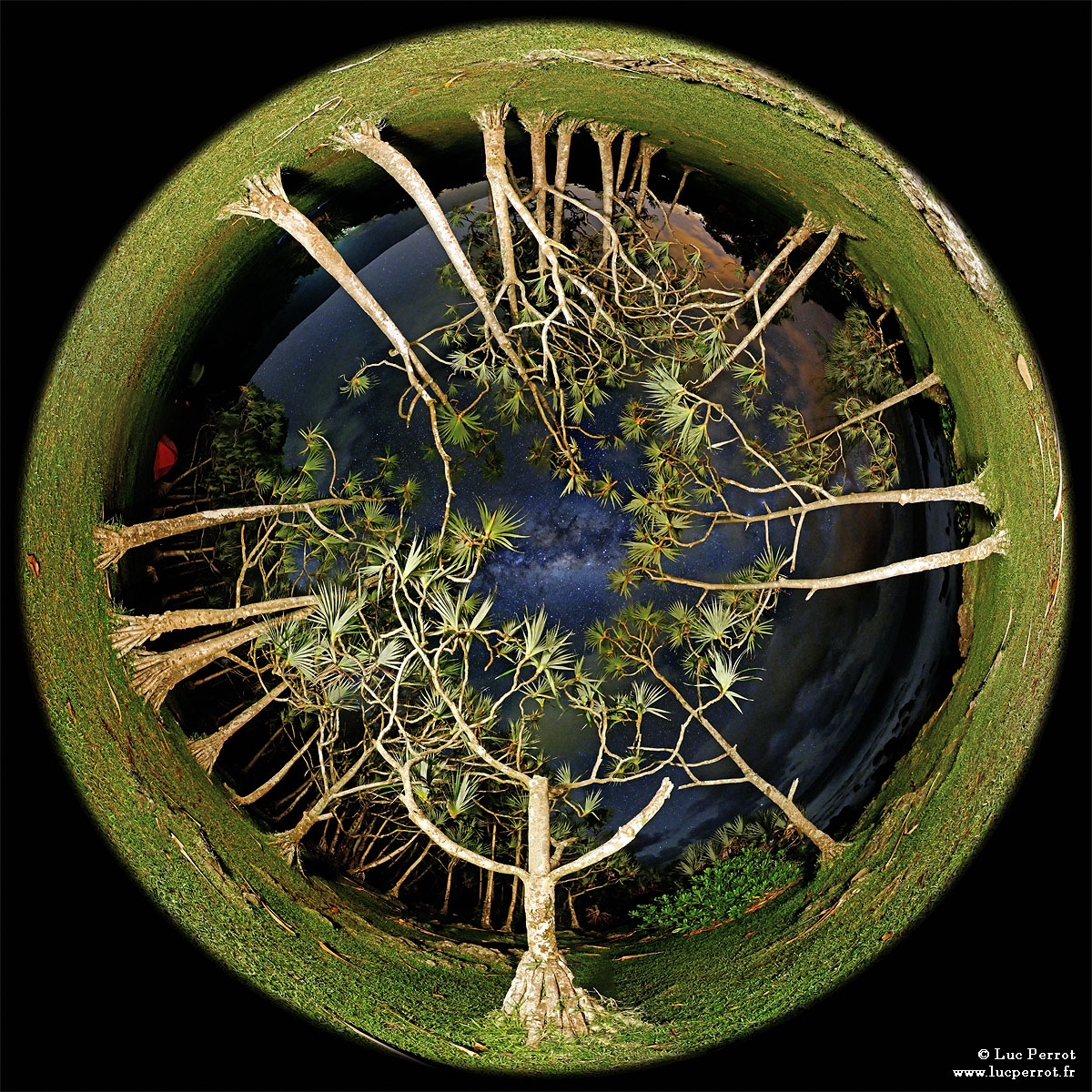
    "Is beauty in the eye of this beholder? Earlier this month, over Réunion Island in the Indian Ocean, a playful photographer with an eye for the sky took eight images and composed the above intriguing picture. The full fisheye frame shows everything above the horizon, including a lamp-illuminated landscape around the edges, and the zenith of the sky directly overhead. The image, however, may be more than beautiful -- it may also be a scavenger hunt. Can you find the photographer's tent, the slope of a volcano (active Piton de la Fournaise), a picturesque shoreline, and the lights of the nearby town (Saint Philippe)? One remarkable feature of the above image is that its center contains the very center of our Milky Way Galaxy."
    http://antwrp.gsfc.nasa.gov/apod/ap100629.html