Monday, December 26, 2011


photo © P. Letellier

Entre-Deux is a commune (municipality) in the south of Reunion. It's name ("between two") comes from the fact that it lies between the Bras de Cilaos and Bras de la Plaine rivers. It became a commune on March 31st 1882.


One recent Sunday a group of us took part in a guided tour of the small town. Although I'd been several times before, it had often only been a stop when passing through on our way to start a hike to the Dimitile (1837m).

our guide, Etienne
photo © P. Letellier

We met in front of the town's tourist office.

Entre Deux tourist office
photo © P. Letellier

The town itself is quite small; the whole commune has a population of only 6000.

Abolition of slavery monument
photo © P. Letellier

sculpture
photo © P. Letellier

Entre-Deux church
photo © P. Letellier

This Chinese-owned corner shop has existed for 150 years

L'Arbre à Palabres is one of the town's restaurants.

One of the most interesting things in Entre-Deux is the variety of lambrequins decorating house facades. Lambrequins are ornamental decorations on roof edges, and are typical in traditional Creole architecture. Design themes often reflect plant life.


The word "lambrequin" originally comes from the Dutch lamperkijn and is variously referred to in Reunion Creole as lanbrokin, dantèl la kaz or dantèl dovan.


Although lambrequins are by no means unique to Entre-Deux, the town has managed to preserve a great variety of them.


Lambrequins were originally a feature of naval architecture.


Most of the lambrequins in the town are made of metal, although they can also be made of wood.


When it rains the water runs to the point, before falling onto the ground. 


This was useful at a time when gutters did not yet exist.


The town has many well-preserved traditional Creole houses, the oldest dates from 1863. Below is a selection of cases.

house of a former Mayor

Case is the Reunion Creole word for a house.

photo © P. Letellier

this house is covered in wooden shingles, known locally as bardeaux

photo © P. Letellier


another shingle-covered building
photo © P. Letellier

modern house, built in a traditional style

The variety of trees, plants and fruits in Entre-Deux is interesting too. Again, you will find nothing that you cannot find elsewhere on the island, but the local micro-climate combined with town conservation means that many different species are concentrated in the commune.

lychee tree
photo © P. Letellier

garden of the Tourist office
photo © P. Letellier

mango tree

Entre-Deux is one of the few places on Reunion where the rare Bourbon pointu coffee is grown (coffea arabica var. laurina). Bourbon pointu is the second most expensive coffee in the world. Bourbon is a former name of Reunion. If you look at the town's coat of arms (see photo at the top of the post) you'll see that it's composed of three coffee grains.

bourbon pointu coffee plant 

grapefruit (citrus grandis)

Water apples are known in Reunion Creole as jamalac, or poire d'eau in French.

Water apples (syzgium samarangense)
photo © P. Letellier

Jack fruit (artocarpus heterophyllus)

Cocoa beans (theobroma cacoa)
photo © P. Letellier

These fruit are less common, they are known as giant granadillas in English and barbadine in French (passiflora quadrangularis).

giant granadillas

This staghorn fern grows on a lychee tree said to date from 1865.

Staghorn fern (Platycerium bifurcatum), known locally as
corne de cerf or corne d'élan  (photo © P. Letellier)

This is Crepe myrtle (lagerstroemia indica) known locally as Goyavier fleur or Lilas des indes:

photo © P. Letellier

photo © P. Letellier

Hibiscus
photo © P. Letellier

Jade vine (strongylodon macrobotrys)
photo © P. Letellier
 Orchids:

photo © P. Letellier

photo © P. Letellier

Local wildlife!

photo © P. Letellier

Outside the town at Bras Long is a picnic area, where we saw this fairly large St Expeditus shrine - they are often much smaller. St Expeditus is a Roman soldier saint who is particularly venerated on Reunion.


Not far away is a view point across the river valley to the commune of Le Tampon.

looking across to Bras de Pontho, part of Le Tampon

Afterwards we went for a lovely farmhouse lunch at "Chez Josian et Celine."

Prawn & jackfruit and guinea-fowl carris

In 2002 a bridge known as the Bras de la Plaine bridge was opened that made it much easier to access Entre-Deux. It is 145 metres high and spans 281 metres across the Bras de la plaine river.

Bras de la Plaine bridge

Thursday, December 22, 2011


The full title of this book by William Dudley Oliver (WDO) is "Crags And Craters: Rambles In The Island Of Reunion". Originally published by Longmans, Green, and Co. in  1896 it has been republished by Bibliolife as an exact reproduction (i.e. it's not an OCRed copy). However Bibliolife made an error with the title and called it "RambleRs in the island of Reunion".

Hell-bourg

The author spent six months in Reunion from July 1895 to January 1896.  We never find out much about the writer or why he came to Réunion, although it would seem he knew previously the then British Consul on Reunion, Courtenay Walter Bennett. According to this link Bennett had been named Consul to Reunion in 1890. A British Consul on Reunion at that time would have had quite a lot of work as there were many indentured Indian labourers on the island, and as India belonged to Britain at the time, they fell under his jurisdiction.


Sir Courtenay Walter Bennett in 1932
© National Portrait Gallery, London


Coming back to the author, as a 19th century white and (presumably) upper class male he came to the island with a baggage of colonial beliefs and prejudices rather typical of his upbringing, and this should be borne in mind while reading the book. However despite this, on the whole he is generally fair and decent in his written treatment of the island's inhabitants.

The Gros Morne

While on the island and not hiking he seems to have spent much of his time in Hellbourg at the Châlet Consulat due to the heat on the coast. "It is an absolute necessity for Europeans dwelling in a tropical climate to have some place to which they can go to recruit their exhausted energies"(page 46).

Gorges of the Rivière des Galets

Possessed with a lot of energy and/or curiosity he hires a guide and some porters (who all walk barefoot!), and over the course of six months manages to visit most of Réunion's summits: the volcano, Piton des Neiges, the Salazes etc. When unable to reach a peak first time, he returns to try again! The only mountain that he didn't manage to  conquer was the Gros Morne, unsurprisingly (it was only ascended for the first time in 1939).

View Near Cilaos


For anybody who knows Reunion many of the place names he mentions will be very familiar : Cap Anglais, Belouve, Coteau Maigre, Cap Noir, etc. etc. However some things which have disappeared today are striking to the modern-day reader: for example WDO often uses the railway, and he makes a trip to the village of Mafate (in the eponymous cirque) which disappeared in 1913.

The Piton des Neiges

I'll leave the last word to the author, who was on his way to the cirque of Salazie: "... I felt that this drive alone was worth the voyage to Reunion. And yet, grand as it is, it is but a foretaste of the glories awaiting in this wonderful island." Sentiments with which a modern day visitor to Reunion might well agree.


Footnote 1:

On pages 25-26 of the book WD Oliver mentions "an obelisk built of native stone and mounted on a pedestal" which had been "erected to the memory of the English who fell at the taking of the island in 1810." He includes a photo of the obelisk set on the (then) visibly grassy Plaine de la Redoute. 
Curious, I went to see the monument as it today. It is now part of a small park and stands not far from the (much larger) French monument to those who fell at the same battle.

The obelisk today (source)

Two sides of the pedestal are blank, on one side is the following inscription: 

"Sacred to the memory of 
Lieutenant John Graham Munro
of his Britannic Majesty's 86th Grenadiers 
who fell near this spot 
while charging the Enemy 
on the 8th July 1810
Aged 22 years
This tomb is erected by his Brother Officers
in testimony of their Esteem and Regard."

inscription to the memory of Lt. Munro

On the other side is the following inscription:

"Near this spot 
Are also interred
the remains of those Brave Soldiers
of his Majesty's
Eighty Sixth Regiment
who likewise fell
on the same glorious occsion"

inscription to the memory of the other "brave soldiers"

As you can see "occasion" is missing an 'a' in the original. Talking of omissions, in a footnote on the subject of the monuments the author says "there is a story that a certain Governor of Réunion, in a copy of the inscription which he made, carefully omitted the word 'glorious' - an instance of small-mindedness which it would be difficult to beat".

The French obelisk, erected in 1857

During the battle 7-9 July 1810 exact numbers of French losses are unknown, but the British lost 22 men and 79 were wounded.

inscription on French monument

Footnote 2:

On pages 159-161 the author says:
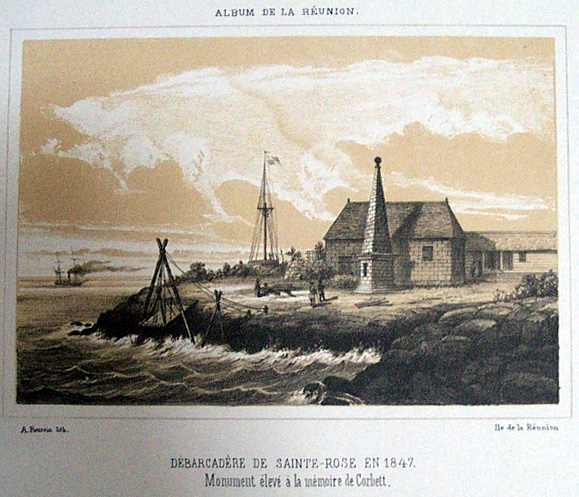
Before breakfast I walked down to the little quay [of Sainte Rose] to take a photograph of the monument erected there to the memory of Captain Robert Corbett, who was killed in action off here on September 13th 1810 while in command of the Africaine. The monument consists of an obelisk close to the shore, and, with the exception of an anchor in relief, is without ornament. There is no inscription.

An 1847 engraving of the port of Sainte Rose, showing the monument

Here are some modern-day photos of the statue at Sainte Rose:

Corbett monument, Sainte Rose

The anchor in relief referred to is found on two sides of the obelisk.

another view of the monument, showing one of the anchors

Near the monument is a plaque, unveiled by Ste Rose's mayor on 23rd August 2009 to mark the 200th anniversary of a slightly earlier battle, and which reads:
Place du Commandant Hubert Delisle.
Historical site of the 23rd August 1809 naval battle between the French and the British.
Commemorative plaque

one of three nearby cannons


Further reading:


You might also enjoy: 

Monday, December 19, 2011

A few days ago we went "canoe rafting" down the Rivière des Marsouins, one of the rivers on Reunion's east coast.

Rivière des Marsouins

Canoe-rafting is basically canoeing in a two-person inflatable canoe rather like a small raft.

example of a canoe-raft

We went with Oasis Eaux Vives, one of several companies who offer this type of activity on Reunion, and actually the same company with whom I did my hen party activity a few years ago (a water ramble - but that's another story!).


You can choose a full-day or half-day activity - our group had chosen the latter.  The actual river descent was interspersed with a few stops. One was to jump into the river from some rocks using a rope:


and another was practicing going downriver in the security position (feet first, body as flat as possible):

before going down river in the security position
we had to get to the middle of the river - no easy task!


All in all a great outing was had by all !


Monday, December 12, 2011

I wanted to share these lovely videos of underwater images from Reunion with you.


Films by Reunion Underwater. Click here and here for the original links.

Do you have any underwater videos you'd like to share?

For more diving-related posts follow this link.