Sunday, September 15, 2013

The Mascarin Botanical Conservatory (Conservatoire Botanique de Mascarin) is a botanical garden and national conservatory covering 12.5 hectares located above Saint-Leu at an elevation of 500 metres.


Like several other places in Reunion it's somewhere I'd visited before, about 15 years ago, but not recently.

water lily & fish

It's home to plants that are endemic to Réunion and found nowhere else in the world, and also has collections of coffee trees, tropical fruit trees, palm trees, cacti, orchids and ferns. 

Vetiver

It was established in 1986 on land which originally belonged to the family of the Marquis Antoine Sosthène Armand de Châteauvieux.

looking across the garden to the adjacent hillsides

In 1993 it became one of France's eight Conservatoires Botaniques Nationaux (National Botanical Conservatories). It not only focuses on the conservation, cultivation and propagation of rare and threatened plants endemic to Réunion, but also the management and monitoring of species in their natural habitats.

cup of gold vine and bougainvillea

Glossary:
  • Indigenous (or native) - an organism growing naturally, brought by birds or wind but not by man, the same organism may be found elsewhere in the world. Reunion has 848 indigenous species, which account for 49% of the island's flora. 605 species are flowering plants, and the remaining 243 species are spore-producing (e.g. ferns).
  • Endemic - a unique native organism which is confined to a well-defined area and has evolved into a species of its own. Of the 848 indigenous species, 237 (28%) are endemic to Reunion, and 153 (18%) are endemic to the Mascarene Islands.
  • Exotic - an organism introduced by man. Reunion has 867 exotic species (not counting cultivated plants).


The actual garden covers 3 hectares and contains about 4000 plant species endemic to the Mascarene Islands. It's organised into seven sections:
  • Réunion collection - indigenous flora, including more than 50 endemic species.
  • 'Lontan' plants - a historical collection of local agricultural plants, including coffee, spices, fruit trees, sugar cane, and geraniums.
  • Orchard - more than 50 fruit tree species.
  • Succulents - succulent plants and exotic cacti, including species from the Americas and Africa.
  • Palm trees - endemic and exotic palm trees.
  • Orchids - orchids and ferns.
  • Bamboo ravine - bamboos.

colour-coded map showing the Garden's seven different sections

The Mascarene islands consist of Reunion, Mauritius and Rodrigues. While Reunion has managed to keep 30-40% of its original vegetation, in Mauritius this figure drops to 2% and on Rodrigues it's less than 4%. Although Rodrigues has  50 indigenous species and 40 endemic species all of the latter are considered rare, endangered or vulnerable.

artwork in the garden using wire and organic matter

We started our visit by a guided tour of the Reunion collection, which represents what the leeward, semi-arid west coast probably looked like about 400 years ago before humans arrived.

general view of part of the Reunion collection

The Mazambron marron (aloe macra) is a species of Aloe endemic to Reunion. It was formerly used to treat boils and to wean breastfed babies as it has a bitter taste.

Aloe macra,  known as Mazambron marron

The Song of India or Pleomele (Dracaena reflexa), known locally as Bois de Chandelle, can sometimes grow up to 15 metres high but its normal height is 4-5 metres. It's often used as a tutor for vanilla cultivation.

Bois de chandelle / Song of India

The collection of cacti and succulents show how plants have the ability to adapt to particularly difficult conditions such as lack of water.

view of the cactus & succulent collection, showing a baobab (right)

The Crown of thorns is a succulent shrub indigenous to Madagascar which can grow  to about 2 metres tall.

Crown of thorns


The cactus known as Barbary fig is native to Mexico, but can also be found in many other parts of the world.

Barbary fig flowers

the fruits of the barbary fig are known as tuna

an interesting 'prickly' tree trunk 

The palm collection not only presents species endemic to Reunion, but also from other countries. The Red Latan Palm is an endangered species of palm endemic to Reunion which can grow up to 12 metres high. Its trunk was used for house construction, its leaves were used for roofing and its fruit, known locally as pomme latanier, is the island's only endemic fruit.

Red Latan Palm known as Latanier Rouge in Reunion

I was interested to see the four talipots, a palm which is native to Sri Lanka. The ones in the garden have not yet reached their full height, which can be 25 metres. What is remarkable about these palms is that they flower once, only after up to 70 years. It takes a year for the fruit to mature, then the palm dies. I've only ever seen one talipot flower, in the 1990s in Saint Denis' Jardin de l'Etat.

Talipot

There are 100 000 species of  orchids and 10 000 species of ferns in the world - obviously the Mascarin Garden can only show a tiny percentage of these. Reunion has 120 species of endemic orchids.

these ferns have been planted in an old manure storage pit


Cymbidium orchid


Vanda orchid

On the property the main house and some outbuildings have survived. They were built by the Marquis Antoine Sosthènes d'Armand de Chateauvieux who settled here in 1857 with his wife and ten children. His estate originally covered 660 hectares, stretching from the coast to the mountains. 

the main house

The interior of the main house has been renovated and decorated with period furniture.


back of the main house

the old stables have been converted into an outdoor eating area

Useful information:
  • Open Tuesday to Sunday from 9 a.m. to 5 p.m. 
  • Guided visits at 11 a.m. (except Saturdays), 2 p.m. and 3 p.m. 
  • An admission fee is charged.


    Useful links:

    Thursday, September 5, 2013

    Réunion Tourisme, the local tourist organisation, has just released an English version of their video about scuba diving in Reunion Island. You can see it below:


    You might also like:

    Tuesday, September 3, 2013

    To me what is most striking about the Chapelle Pointue (Pointed Chapel) is not its pointed spire, but its round, rotunda shape. Located in an area of Reunion known as St Gilles Les Hauts this chapel is the burial place for Mme Ombline Desbassayns, a wealthy 19th century landowner whose fortune came from sugar and coffee. Born to a rich family in 1755, she married wealthy settler Henri Paulin Panon Debassayns when she was 14 and he was 38. They had 13 children (though 4 died young) and her husband died aged 68, leaving her, aged 45, to run the family estates, which prospered, making her St Paul's richest landowner. 

    Mme Desbassayns (source)

    She died in 1846 and the jury is still out on whether she was a cruel woman whose ghost still inhabits the Piton de la Fournaise (where her screams can supposedly be heard from the hellish fires whenever the volcano is erupting), or whether she was - as her tombstone declares - the "second providence". Doubtless the truth probably lies somewhere between these two extremes. 

    Chapelle Pointue

    In order to give her slaves religious instruction and to offer a place of worship to those living in Reunion's highlands Mme Desbassayns established a chapel in the 1830s in one of her houses, at a place called l'Ermitage. Until then you had to go to the church in St Paul. Then a new rotunda-shaped chapel was built to the east of the main house (the Musée de Villèle today) on land overlooking St Gilles ravine. The first stone was laid on November 17th 1841 in the presence of the Governor Rear Admiral de Hell (who gave his name to Hellbourg), and the construction lasted 21 months. It was inaugurated on August 16th 1843 by Bishop Poncelet.

    This stone commemorates the chapel's
    inauguration and reads: "Dedicated to the piety 
    of the faithful at the initiative of B. Ombeline M. 
    Montbrun widow Panon Desbassayns, this 
    cornerstone was erected in the year of our Lord 
    1841 in the presence and with the blessing of 
    the Apostolic Vicar Bishop Dalmont 
    and Rear Admiral de Hell".

    In 1856 a new, larger parish church was built in Saint Gilles les Hauts and the Chapelle Pointue essentially became a family chapel. In 1866, twenty years after her death, Mme Desbassayns' ashes were transferred from the Marine Cemetery of St Paul to the chapel. 

    Mme Desbassyns' tombstone in the chapel,
     which refers to her as the "Second Providence".

    During the second half of the 19th century a Jesuit missionary undertook to decorate the chapel's interior. The building was almost completely destroyed on February 4th 1932 (the anniversary of Mme Desbassayns' death) by a violent cyclone, and was reconstructed the following year with a few changes, notably the opening of four doors in the rotunda wall. In 1934 the rebuilt chapel was re-inaugurated by Bishop de Beaumont, whose motto 'With Bravery to Martyrdom' (Avec courage jusqu'au martyr) is inscribed on the coat of arms above the entrance porch.

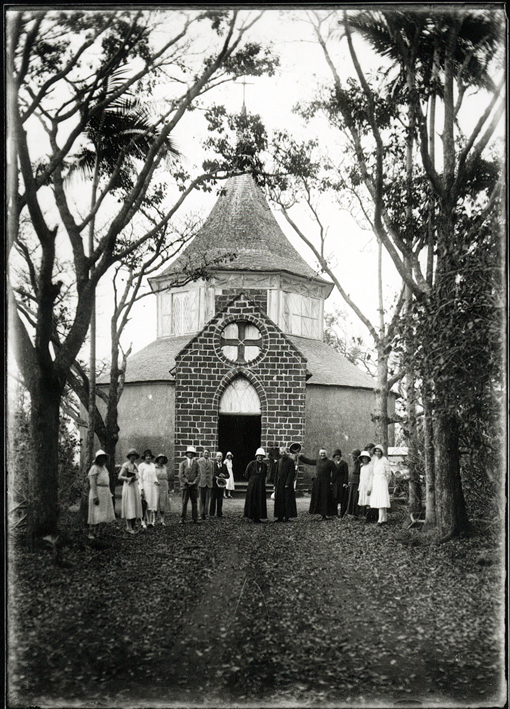
    the chapel in the 1930s (source)

    In 1970 the building was classed as a heritage site, and in 1978 it came under the ownership of Reunion's General Council, who signed a 99-year lease with the Diocese Association. The General Council worked hand-in-hand with the Regional Office of Cultural Affairs to fully renovate the chapel between 2001-2003.

    inside the chapel

    The white marble altar was carved in Nantes in 1845 by the sculptor Vital Bousquet.

    inside the chapel, showing the white marble altar 


    The architecture of the building is composite, combining neo-Gothic style (ogival archways) with Asian influences (a roof reminiscent of a Chinese pagoda). 

    makeshift shrines outside the chapel

    The chapel is dedicated to the Virgin Mary and Sainte Ombeline.

    a statue of St George in the chapel

     The chapel is indicated by signs, and is free to visit.


    Sunday, September 1, 2013

    Astronaut Karen Nyberg recently took this photo of Reunion and Mauritius from space. Nyberg was the 50th woman in space and is currently in Expedition 36 on the International Space Station. The Seven Sisters star cluster is also known as the Pleiades. You can see the photo on Karen's Facebook page here.


    "Seven Sisters overlooking Reunion and Mauritius Islands in a
    moonlit Indian Ocean. Taken August 25, 2013. KN from space."

    Cosmonaut Pavel Vinogradov, current commander of the International Space Station (ISS), has also taken photos of Reunion from space. As of May 2013, Vinogradov has flown into space three times, has conducted seven spacewalks and is one of the top 20 astronauts in terms of total time in space. He is currently in space for the duration of ISS Expeditions 35 and 36, from March to September 2013. The ISS flies over Reunion at least twice a day at an altitude of 400km. The first two photos below were taken on April 9th 2013.

    photo of Reunion Island from space taken on April 9th 2013 by Pavel Vinogradov

    photo of Reunion from space taken on April 9th 2013 by P. Vinogradov

    photo of Reunion Island in space taken by Pavel Vinogradov

    In 1997 students from a school in Reunion (College Jules Reydellet), together with Russian space scientist Vladimir Syromyatnikov, put into orbit Sputnik 40, the first school satellite in the world. Sputnik 40 was a Franco-Russian amateur radio satellite launched to commemorate the fortieth anniversary of the launch of Sputnik 1, the world's first artificial satellite. A 4-kilogram one-third scale model of Sputnik 1, Sputnik 40 was deployed from the Mir space station on 3 November 1997. Built by the school students from Reunion, the spacecraft was constructed at the Polytechnic Laboratory of Nalchik in Kabardino-Balkaria, whilst its transmitter was assembled by the school in Réunion with technical support from AMSAT-France.

    Sputnik 40

    Vladimir Syromyatnikov (1933-2006) was best known for designing docking mechanisms for manned spacecraft; it was his Androgynous Peripheral Attach System which, in the 1970s, linked the Soviet and American space capsules in the Apollo-Soyuz test flight. Syromyatnikov also helped design and develop Vostok, the world's first manned spacecraft, which launched Yuri Gagarin into space in 1961. In the 1990s, he updated the design of his docking mechanism for the meeting of the Mir space station and the Atlantis space shuttle. Syromyatnikov's designs are still used by spacecraft visiting the International Space Station. 

    Vladimir Syromyatnikov in 2006 (Credits: Alexander Gronsky)

    In November 2012 a memorial to Vladimir Syromyatnikov was inaugurated in St Denis, Reunion – a sculpture of the docking mechanism he designed, placed in the middle of a roundabout. Syromyatnikov popularised space in Reunion on his many visits to the island. Syromyatnikov’s son Anton attended the inauguration and took the photos below.

    the memorial to Vladimir Syromyatnikov (photo Anton Syromyatnikov)

    the memorial at night (photo Anton Syromyatnikov)

    Another ambitious project is currently underway to make the most of under-used airspace in the south of Reunion for the development of sub-orbital space tourism. For the past two years, consideration has been given to this subject, and a presentation of "South Indian Ocean Spaceport Dreams" was made ​​in Nagoya, Japan in June 2013 at the "29th International Symposium on Space Technology and Science" by Jean-Marc Péquin, President of the Reunion Science Park and Ryojiro Akiba, former Director General of ISAS Space Agency (JAXA) and current President of the Aero-Space Incubator of Hokkaido Region.

    If you're interested in seeing photos of space from Reunion, take a look at some of Luc Perrot's photos on his website or here on my blog.


    Friday, August 30, 2013

    'On Bourbon Island off the coast of Madagascar, a French ornithologist and his assistant are caught up in an adventure involving slavery, colonialism, and the last days of the great pirates'. So goes the summary of the 288-page black and white graphic novel Bourbon Island 1730, by Lewis Trondheim and Appollo, translated into English by Alexis Siegel.

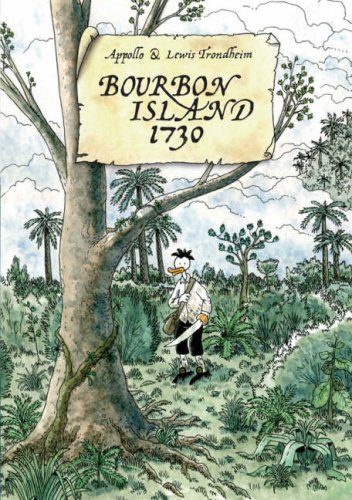
    front cover, Bourbon Island 1730

    Although I could have read the original in French (despite their names, both authors are French) I was eager to read a rare English translation of a book about Reunion Island ('Bourbon' is the former name of Reunion).

    back cover

    In a colonial community that is just beginning to find itself, the ornithologist Despentes and his assistant Raphael Pommery are supposed to be in search of the almost-extinct local version of the dodo - the solitaire - but Pommery is soon entranced with the pirate inhabitants of the island, becoming obsessed with the romance of a vision of the world where all people are free and equal regardless of their skin colour. Against a backdrop of slavery former freebooters debate whether to try and release from jail the infamous pirate 'Buzzard' (Olivier Levasseur aka La Buse) by a show of force. In the end however the ornithologists are witness to the extinction of both bird and pirate.

    Gravestone of the pirate La Buse in St Paul, Reunion (source)

    This historical drama is published by First Second and is printed on good quality heavy paper stock (with a torn effect edging - similar to a pirate's treasure map?), featuring anthropomorphised animal characters, drawn in black and white by Lewis Trondheim (real name Laurent Chabosy). Trondheim and Appollo (a pseudonym for Olivier Appollodorus, who knows Reunion well) both wrote the fictional story, which is freely inspired by past events, and is not intended to be a historical account.  The detailed endnotes however indicate the reliance on historical facts and documents for some of the background for the story.

    "And there young man, what do you see?"
    An example of the book's animal characters.

    Although the characters are portrayed as animals this does not make them 'cute'. Trondheim’s pen-and-ink style of drawing took me a little getting used to, and the characters don't always 'stick out' visually. More of an intellectual than physical adventure, the story explores the world of pirates and early colonialism, and the exploitation of slaves. The translation is generally excellent, apart from a few translations of local terms that I found rather jarring (an occupational hazard for me perhaps?). At the end are detailed notes which help to connect you to this period of history. Although I've spent almost 20 years on Reunion and consider myself fairly knowledgeable about the island's history there were several points I was interested to learn about it. The ending is rather abrupt, but overall this was a very enjoyable read.


    The Cryptogram of Olivier Levasseur
    Olivier Levasseur's cryptogram, thrown to the crowd from the scaffold before he was hung (Wikipedia)

    I would recommend it to any adult or young adult who has an interest in 18th century history, pirates, colonialism, slavery or Reunion and the Indian Ocean.

    Book details: 
    Bourbon Island 1730 by Lewis Trondheim and Olivier Appollodorus, 288 pages, published by First Second, October 2008, ISBN-13: 978-1596432581.


    Translations of the book into other languages also exist:

    Further reading:

    Appollo also wrote a graphic novel in two volumes set at Maison Rouge, an old colonial estate which I blogged about here.


    If you enjoyed this post you might also like:

    Monday, August 19, 2013


    The most striking thing about Seton Collegiate Church when you see it for the first time is its truncated spire, which was apparently precluded by the Reformation. It is one of the finest surviving collegiate churches in Scotland and owes much of its grandeur to the Seton family, whose palace was near the church. It is located in a peaceful woodland setting in East Lothian (Scotland) and is sometimes still used for weddings.

    Seton Church from the south

    In 1242 a parish church dedicated to St Mary and the Holy Cross was consecrated on the site by the Bishop of St Andrews, probably a simple rectangular structure which later became the - now demolished - nave of the building. Around 1434 Lady Katherine St Clair, the widow of Sir John Seton,  added a chantry chapel to house his tomb. Lady Katherine's grandson, the 1st Lord Seton, founded the church and college of priests  in 1470 without securing papal permission. Approval from Pope Alexander VI secured collegiate status in 1492. (Collegiate churches got their name from the college of priests - generally established by wealthy families - to say prayers for their souls in order to win forgiveness and salvation). 

    west face of the church, showing remains of demolished nave

    In 1544 however during the 'Rough Wooing' conflict English troops damaged the church, burning the timber work and stealing the bells and organ. The 1560 Scottish Reformation outlawed mass and thus effectively brought an end to the collegiate life. Seton Church briefly became a parish church before becoming a private chapel for the Seton family. In 1603 King James VI was on his way to his coronation in London when he stopped here to attend the funeral of his friend the 6th Lord Seton. The Jacobite Setons lost their lands in the 1715 Rising because they had supported the exiled 'Old Pretender' James Edward Stuart, and the church was ransacked and ceased being a place of worship; at one point in the 19th century is was even a carpenter's workshop. In 1878 the Earl of Wemyss became the new owner of the church and restored the building as a family burial place. In the 1940s it passed into state care.

    the fine vaulted ceiling

    A bell in the south transept was made in Holland in 1577 for the 5th Lord Seton, and is a rare survival from that period.

    bell dating from 1577

    In the choir/chancel area a mural tomb has unknown effigies of a knight and his lady dressed in 15th century clothes, possibly members of the Seton family.

    Mural tomb with unknown effigies of a knight and his lady

    A door in the north wall leads to the sacristy, where the priests would have prepared for mass.

    looking out of the sacristy into the choir area

    The transepts (north and south) were erected sometime between 1513 and 1588.

    the north transept

    carved bust located in the south transept

    carved corbel


    Like Rosslyn Chapel, 9 miles away, Seton also has a legend of a murdered apprentice. The story is that the Master Mason in charge of building the church had a major problem erecting the vaulted roof of the nave and went to another church to examine how the vaulted roof there had been erected. Given that there were a number of churches in the vicinity with vaulted roofs it seems likely that a long journey was not involved. In the absence of the Master Mason an apprentice had made the mathematical calculations and drawings showing how the vaulted roof could be built. The Master Mason, his pride being badly bruised (not to mention his ruined reputation of as ‘Master’), flew into a rage and hit the apprentice with a mallet killing him on the spot. The reporter was informed by a local worthy, from Port Seton, that it was believed that the Seton Master Mason was none other than the disgraced Master Mason from Rosslyn Collegiate Church who had not in fact committed suicide after killing the Apprentice there but had moved to Seton in order to design and later build that church the construction of which began in 1470. 

    Murdered apprentice carving in Seton Church

    In the south transept is a splendid monument to James, 1st Earl of Perth who died in 1611.


    detail of the monument, showing a skull at the top

    In the 1400s Seton Palace was built for the Seton family, and was described as one of the greatest houses in Scotland of that time.  The palace later fell into ruin and was eventually demolished in 1789 to make way for a new house, called Seton House or Seton Castle today, designed by renowned architect Robert Adam. Immediately to the west of the church, Seton House was recently sold for £5 million, making it one of Scotland's most expensive private homes.

    Seton House

    Outside, to the south-west of the church, are foundations that may be a rare example of priests' accommodation. At its height one provost, eight canons, two choristers and a clerk all lived here, praying for the salvation of Lord Seton and his family. They were probably later re-used as outbuildings for Seton Palace and include a mill and a brewhouse. They were uncovered during clearance work in the 1950s.

    remains of priests' domestic quarters


    Directions: 
    Seton Collegiate Church is located to the immediate south-east of Port Seton in Longniddry, East Lothian, EH32 0PG.
    There is a small car park situated approximately 1.5km west of Longniddry on the B1961 just as it turns into a dual carriageway.

    Additional Information: 
    • Admission charges. 
    • Seasonal opening hours: April to September Monday to Sunday 9.30am - 5.30pm. Closed in winter.
    • Tel: 01875 813334

    Friday, August 2, 2013


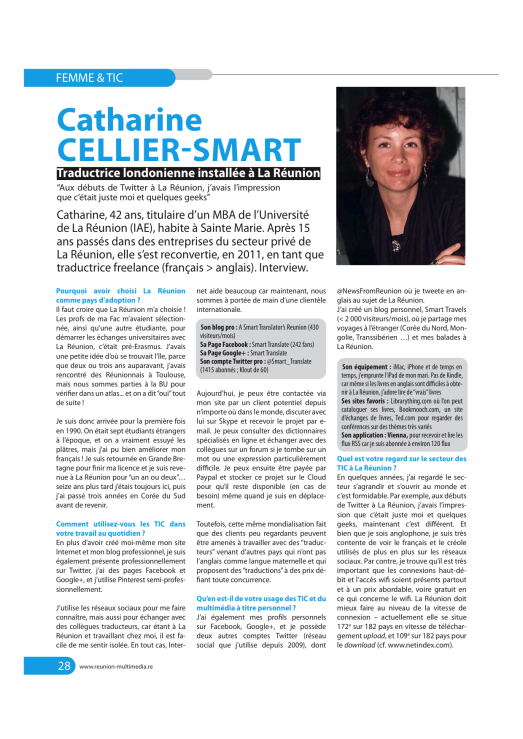
    Following on from a short article about my blogs in a previous issue (see here), the local magazine Reunion Multimedia published a full page interview with me in its June-July 2013 issue. The theme was information and communications technology. You can click here for a larger, more readable copy of the interview (in French).

    RM 113 28

    Thanks to writer and journalist Julie Marianna David for conducting this interview.


    You might also like: