Friday, March 27, 2009

Last month we spent two weeks travelling in the Philippines. First we flew from Seoul to Manila, then travelled to a resort on the north coast of the island of Mindoro for a few days before heading to a small island called Pandan off the west coast of Mindoro for more diving. After a few days we crossed the Mindoro strait and stayed on Dimakya island, near Busuanga in Northern Palawan.  It was mainly a scuba diving trip  and while diving we saw a shark, turtles, and sea snakes (one was more than 2m long).  Afterwards we were told that the sea-snakes are 17 times more venomous than cobras ... (but they can't open their jaws wide enough to bite humans apparently). We also did a great wreck dive on a big Japanese warship sunk since 1944 - very atmospheric. 

Jeepneys - typical Filipino mode of transport

en route for Pandan island


Mindoro landscape

noisy bats on Dimakya island !

Intramuros in old Manila

Tuesday, March 17, 2009


Coming back to Korea after a trip we've just made abroad I realised that I no longer felt Korea was such a strange place; perhaps after six months we're starting to settle in ?  (The other day when I was walking along the street I even had a taxi driver ask me directions !). Anyway I'd better hurry and jot down my impressions about things here before they really start to seem 'normal'.

Last month we went to the Philippines, we did several dives during the two weeks we were there, and were able to see a shark, turtles, and sea snakes (one was more than 2m long).  Afterwards we were told that the sea-snakes are 17 times more venomous than cobras ... (but they can't open their jaws wide enough to bite humans apparently). We also did a great wreck dive on a big Japanese warship sunk since 1944 - very atmospheric.  Manila on the other hand probably has it good points but we found it mainly dirty and noisy (and hot !).

We also made the most of the long weekend here when there was Lunar New Year to do some travelling locally, and amongst other things we went to the DMZ (DeMilitarized Zone between the two Koreas).  The name is pretty ironic because it's probably one of the most heavily guarded places in the world.  We saw lots of South Korean soldiers but only one North Korean one (although I'm sure there were plenty hiding in the background).


We saw the place where the third world war nearly started when a tree was cut down in the 1970s, and we visited one of the four tunnels that the North Koreans secretly built in order to invade Seoul/South Korea.  


Inside it's painted black and apparently this was going to be the North Korean excuse - pass it off as a mining tunnel; the problem is that the whole area is granite and there's no coal for miles around !  I also recently read a book written by a defector who spent 10 years in a North Korean gulag as a young man, and I went to a conference held by a British tour operator based in Beijing specialised in trips to North Korea. He explained that when he talks to the guides there they've never used internet, a mobile phone or a laptop - although at least they've heard about them, which is not the case out in the N. Korean countryside (Click here for the account of my trip to North Korea in August 2010).

I can't wait for June - not because of the weather but because they'll be bringing out the new 50 000 won bank note (about 25 pounds).  Until now the biggest banknote has been 10000 won (5 pounds), and because cheques don't exist here ("cheques, but not as we know them") you spend most of your time carrying around wads of cash so that you're never caught short. Another idiosyncrasy here is the address system. Each district is sub-divided and in that sub-division buildings carry a number, but not the number of the building next-door.  So 123 is not next-door to 124 for example ....  The postmen know what they're doing with post, but whenever you go to someone's house or a shop you always have to have a map and directions otherwise you'll never find it.  The government is putting into place a system whereby streets have names and building have numbers that follow each other but it won't be finished before we leave Korea.

Winter seems to be almost finished - my husband's first ever - and spring might be here.  The coldest we saw was -15°C. V was delighted to be able to go skiing on Sunday mornings just an hour away from Seoul.  Korea's not a very snowy country - it's too dry - so they make real snow artificially. Koreans aren't early risers (I've been wondering if the country's nickname "Land of the morning calm" was because of this ?) so the ski slopes are pretty empty on Sunday mornings.


Suggested reading:
Korea Unmasked: In Search of the Country, the Society and the People a graphic novel by Rhie Won-Bok 

Saturday, February 28, 2009

If you're female, travel in Korea and use a public toilet you might see one of these on the wall :


If you press the button it doesn't chime but makes the sound of flushing water to cover any unladylike noises you might be making ! I took a photo of this one at Incheon airport en route for the Philippines, but you can see them in many public toilets. Here's another style found in a motorway service station

Wednesday, January 7, 2009

If you don't know much about the South West Indian Ocean, its islands (Reunion, Mauritius, Seychelles, Madagascar and the Comoros) and its inhabitants, here's a good place to start :


Here's an article about the lesser known island of Rodrigues, a dependency of Mauritius, and the smallest inhabited island of the Mascarene Archipelago.

Tuesday, December 23, 2008


We've now been living in South Korea for about 4 months.  We’re coping OK with the weather but so far but we’ve only had a few days of very cold weather. I chatted with someone from Siberia recently who told me she actually prefers winters in Siberia because there’s less wind there ... (I told her they must be sending it all over here to SK). Of course we’ve had to buy everything from scratch (coats, gloves, scarves, footwear, hats etc) as we never needed them in Reunion.


Seoul by night, from our flat

Language-wise we've both been having Korean lessons, but my (French) husband in French and me in English.  We’re both only at the “What is this ? This is a pen” stage.  We know how to read the alphabet but when you decipher a word you don’t necessarily know what it means as most vocabulary is completely different to English, although you can sometimes use your imagination – the Korean words for ‘glass’ and ‘door’ put together mean ‘window’. ‘Han-deupon’ is a cellphone (‘handphone’) for example.  So day-to-day activity is carried out in basic English and/or basic Korean and/or sign language.  I’m actually worried that next time I’m back in the UK I’ll be speaking pidgin English to everyone !  V. managed to have his hair cut at a hairdresser’s where they don’t speak a word of English.  Women being fussier about haircuts, I went to one where I knew they spoke some English.   


not as complicated as it looks actually (image from www.hapkidoselfdefense.com)

 I’ve managed to take the bus a couple of times as well – not as simple as it sounds because unlike the subway system it’s not very non-Korean speaker friendly.  Also the bus drivers, like the taxi drivers, tend to have a whiplash-inducing style of driving.  I’ve actually seen a woman standing in a bus fall over because the driver braked so hard ...  V. got his Korean driving license too, be interesting to see the reaction of a French or British policeman if he has to show it if he gets stopped.  He needed the Korean driving license (I’ve got an international one) for when we hired a car and did our road trip round the peninsula at the end of October.  It was interesting to get out of Seoul, to see that are lots of tower blocks everywhere (just like Seoul) but also a lot less English spoken and less foreigners – although in Seoul there aren’t that many foreigners really.  So when we were sight-seeing if our paths crossed that of a bunch of school children they’d all be shouting “hello, how are you” 60 times to us !  Anyway around the country there are some remarkable and less remarkable sights, you realise how old the country’s history is, but also how much it has suffered from repeated foreign invasions.

Other interesting experiences were V. tasting silk-worm pupa (a great delicacy here) and having a violent allergic reaction to them.  He’s not an allergic person and often ate wasp larvae in Reunion so we were surprised.  I can just imagine him seeing a European doctor for the first time who asks him if he’s allergic to anything “Oh yes, just silk worm larva ...”.   


silk worm larva, known as beondegi in Korean

Also on the health front I found out that only 0.5% of Koreans have my blood group (A-), the same goes for all negative blood groups (in Europe its about 6% per negative blood group) , so basically if you’re Rhesus negative and you ever need a lot of blood you’re unlikely to get it here.  So if you were wondering what to send me for Christmas now you know – some A- blood !  

In October during one of my Korean tea ceremony classes we heard a very loud siren going off everywhere.  Apparently every so often there are drills in case of an attack by North Korea.  In fact an armistice was never signed at the end of the Korean war, there was just a ceasefire.  I’d like to go on a trip to North Korea, but about 2 weeks ago they tightened security and it’s currently not possible.
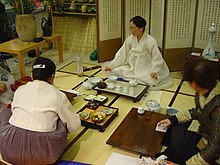
Korean tea ceremony (photo Wikiepdia)

We did a temple stay last month. A group of us went on an organised trip to a Buddhist temple in Ganghwado – I wanted to go not so much for the religious side of things but cultural as Buddhism and Buddhist thinking is an important part of life here even though Korea is the most Christian country in this part of Asia.  So we participated in meditation, chanting, ‘work’ (chrysanthemum flower picking) and calligraphy.


calligraphy

tea with the head monk

during a service


This being Asia everything takes place sitting on the floor, including eating meals (you sleep on the floor too).  But the ‘high’ point was getting up at 3:45am to do 108 salutations at 4am in the temple during morning service ...!   A monk who misses morning service would have to do 3000 salutations to make up for it; apparently this takes about 8 hours.

Less spiritual was the visit I made to the world’s one and only toilet shaped house built by a Korean to raise awareness of all the people without toilets.  It really is a lived-in house (see my picture below). 


I also recently visited the House of Sharing and museum for former “comfort women” from WWII – not an easy visit, but eye-opening all the same.

Suggested reading :
Comfort Woman by Nora Okja Keller

Tuesday, November 25, 2008

I like this video. The music's good, and I think it manages to combine old and modern Korea successfully. What do you think?


Friday, July 25, 2008

All photos by Philippe Letellier.


Before we left Reunion for South Korea we wanted to take a trip to Roche Plate, which is a small village in the river-bed of the Rivière des Remparts, only accessible by foot or by 4-wheel drive vehicule. Roche plate literally means 'flat stone', and it is situated at just over 700m altitude. 
As I'd already been there on foot, and as I own a Suzuki Jimny (soon to be sold before we leave) we chose the easy option!

my Jimny

looking up the Remparts river valley

Remparts is a French word which literally means 'ramparts', but in this context means the cliff walls on either side of the river valley.

rempart

view to the side when travelling upriver


The 'road' is a 13-km long dirt track


and crossing other vehicles can sometimes be difficult as although the river bed is wide, the actual track you can drive on is quite narrow, but we got there safely in the end.

don't attempt this drive if there's been heavy rain

We stayed in the gîte (lodging) in the tiny hamlet of Roche Plate.  This sort of hamlet is known on Reunion as an îlet.

Roche Plate gîte


the gîte's electricity comes from solar panels

The îlet used to be a larger village, but in 1965 an enormous landslide nearby led to it being evacuated, and most people have never moved back.


The next day we walked a short distance up the river. (If you carry on uphill for 17 kilometres you come to a place called Nez de Boeuf at 2000 metres altitude, from where you can walk or drive to the Piton de la Fournaise volcano).

path heading uphill alongside the river


 We found a lovely waterfall.


Many filaos or casuarina trees grow in this area. They have quite distinctive red roots which you can see in the photos below.


By the way, don't confuse this Roche Plate with the other village of Roche Plate which is located in the cirque (volcanic caldera) of Mafate.


Further reading:
You might be interested in this account by a horticulturist of his hike down from Nez De Boeuf to St Joseph.