Sunday, February 17, 2013


Last week I was looking across at Dos d'Ane from Ilet Alcide (see here), this week I was hiking from there! 

Dos d'Ane village, Le Port in the distance 

Dos d'Ane (literally 'Donkey's back') is a farming village in the highlands above the town of La Possession, at about 900-1000m altitude. From a visitor's point of view it is most well-known for Cap Noir and the Roche Verre Bouteille (literally 'Bottle Glass Rock'). Our hike started with a short walk from the car-park to the Cap Noir viewpoint, from where you can see the northern part of Mafate.

the northern part of Mafate seen from Cap Noir,
in the middle is Piton Cabris (1441m)


At Cap Noir we came across the photographer Luc Perrot, - I've already shared several of his amazing photos on this blog. Here's one of the photographs he took from Cap Noir:

© Luc Perrot


looking towards the Grand Bénare (centre) and the Maïdo 

looking west from Cap Noir

After that we quickly gained about 200m in altitude as we hiked up to Roche Verre Bouteille. Altough the rock is shaped like a bottle, it actually gets its name from the Reunion Creole term for "shard of glass".

Roche Verre Bouteille (slightly left of centre) (source)

If you're looking for a short hike once you're at Roche Verre Bouteille you can loop back to the Cap Noir car-park, we however were heading to Plaine d'Affouches along a ridge-top hiking path.

unidentified plant - flowers like jasmine, fruit like coffee

Despite recent rain the weather was magnificent and we had spectacular views across Mafate to the Piton des Neiges.

looking across Mafate, Piton des Neiges back left, Grand Bénare far right

close-up of Piton des Neiges

Affouche is the local name for Ficus densifolia, a plant of the fig family.

note the path steps to the left

We could see the town of Le Port far below.

view of Le Port from the hiking path

We saw quite a few Reunion Harriers (papang) flying, and a few tenrec hunters too, as the hunting season (mid-Febuary to mid-April) had officially just opened.

Terpsiphone bourbonnensis/Mascarene Paradise Flycatcher/Oiseau-la-Vierge

The closer we got to Saint Denis the thicker the vegetation became.

forest vegetation

After almost 9 km of hiking we finally reached a dirt track from where we had a good view of the Saint Denis river valley. 

Saint Denis river valley

Below us, at 700m, we could just see Ilet à Guillaume, a deserted hamlet which used to be a children's prison labour camp 1864-1879. About twelve children are buried there in a small cemetery.


close-up of Ilet à Guillaume

Afterwards we only needed to walk down the flat (but winding) dirt track. 


Three kilometres further on we stopped for lunch at a picnic shelter before being picked up by our transport and heading back to Saint Denis.


looking along the Saint Denis river valley to Saint Denis

one of many pic-nic tables next to the Plaine d'Affouches dirt track 

Plaine d'Affouches map

See also:


    Useful map:

    Tuesday, February 12, 2013


    This hike started at 2000m, a little below the main Maïdo viewpoint. Shortly after you start you come first of all to the paragliding take-off site for Maïdo, then to the start of the hiking path that heads down into the cirque of Mafate.

    start of hiking path into Mafate from Maïdo - 'only' 750m downhill!

    Mafate was not our destination today though, a place called Ilet Alcide was. From the path turn-off we were able to catch a few glimpses of Mafate far below through breaks in the clouds.

    Ilet des Orangers (forefront), and Grande Place (behind)

    We could also see the town of Le Port on the coast, some 2000m below.

    the town of Le Port

    mock strawberry (left) and true strawberry (right)

    In recent years the Maïdo area has suffered from several forest fires at the end of the dry season, and sometimes the effects can still be seen on the vegetation.

    previously burnt bush 

    mistletoe 

    We gradually headed downhill, the lie of the land meaning that we had to follow the path round to the left as there was a 1500m drop to the Rivière des Galets riverbed below us if we carried straight on!

    fungi

    dew-covered spider's web

    We stopped for a short break at a place known as "Les Terrasses" where we had a view across the Rivière des Galets to the village of Dos d'Ane (which literally means ('Donkey's back').

    Dos D'Ane, seen from across the Rivière des Galets

    We also had a different view of Le Port.

    Le Port

    A little further on we finally reached Ilet Alcide, where we had lunch (there are two picnic tables). The lichen-covered wooden sign reads "Welcome to Ilet Alcide, inhabited from 1900-1944 by Clain Vincent Alcide".

    wooden sign, Ilet Alcide

    Today there are no reminders left of Mr Clain, who came here from Mare à Martin in Salazie to cultivate and distill geranium. Before him, in the 18th century, the îlet was inhabited by Mafouta, an escaped slave who gave his name to the cirque of Mafate.

    Hydrangea, Ilet Alcide

    small shrine, Ilet Alcide

    strawberry guava ('goyavier') flowers, Ilet Alcide

    After leaving Ilet Alcide and continuing downhill we eventually came to a sign indicating Sans Souci further down (Sans Souci is a popular starting point for the Canalisation des Orangers hike). We, however, also headed down but inland too, towards the cryptomeria forest.

    Ilet Alcide/Sans Souci sign

    The smell of Ginger lilies became stronger and stronger the further downhill we headed. 

    Hedychium gardnerianum / Ginger lily / Longose

    wild orchid

    The Maïdo (along with Plaine des Cafres) is a place where cattle roam more or less freely, and we finished our 11 km hike at 1300m altitude with them watching us!


    If you enjoyed this post, you might also like:


    Satellite map of hike route


    See also:
    Ilet Alcide (video)

    Saturday, February 9, 2013


    The blurb: American Kit Kincade believes women are little more than a life support system to an ovary. Shelly Green, pinstripe-underpanted, cultured, classical guitarist, thinks optimism is an eye disease and hates all men. The perfect pair? Yes, according to a 'Desperate and Dateless' reality TV competition. A computer has matched them - physically and emotionally - with huge financial rewards if they can survive their five-star honeymoon on the paradise island of Réunion. Kit and Shelly meet the day they are to be married...and it's hate at first sight. Love may be blind, but marriage is a real eye opener.

    You have to suspend your sense of reality to read this chick lit book. Apart from the outlandish plot with more twists and turns than a corkscrew, the author seems to have transposed Mauritius (with its insistent beach hawkers, plethora of aquatic activities, and islets) to Reunion, presumably because the latter served her story better. Effectively there's a freak volcanic eruption (from Piton des Neiges, not Piton de la Fournaise!*) and a lot of anti-French revolutionary activity, neither of which would have been possible on Mauritius. 


    Most of the book takes place on Réunion, and it's a shame that one of the most racially mixed and harmonious places on earth is turned into a blacks vs whites battleground, complete with corrupt machine-gun toting policemen, just for the purpose of Ms Lette's novel. She also invents a downtrodden local indigenous population to suit her storyline. There are numerous other mistakes such as thunder and lightening during a cyclone, and the presence of snakes and mongooses to cite just a few examples. Possibly the best part of the book are all the one-liners, some funny, some corny.

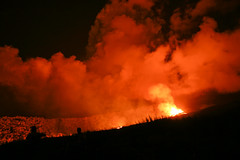
    Eruption de La Fournaise
    Eruption of Piton de La Fournaise volcano (source)

    If you do read this book but have never been to Réunion, please don't believe any of it!


    * Piton des Neiges is a dormant/extinct volcano which last erupted 20 000 years ago, while Piton de la Fournaise is one of the most active volcanoes in the world.

    Monday, January 28, 2013


    Island Awakening by Lynne Martin

    It's been a very long time since I read any romantic fiction, but I was led to read this particular novel because I found out it that it is set on Réunion and this piqued my curiosity.

    The story: Marina Welsh thought a new job on a paradisiacal island  was the best medicine for a broken heart, but her new boss Richard Boyer made her life difficult ... I'll let you guess how the story ends.

    front cover

    Most of the story takes place on Réunion, but the island is only a background to the main story, and despite the enticing cover photos the volcano only gets a brief mention! Other local scenery gets a good mention though. The author has obviously visited Réunion, but gets some of the place names wrong (Villiere instead of Villèle, Trou des Roches instead of Tour des Roches, etc).

    The story holds all the typical clichéd ingredients of romantic fiction and true to the genre you need to suspend your sense of reality; this is especially the case concerning the language issue: Marina only asks what languages are spoken on Réunion when she's already on the plane, and the fact that her French is 'rusty' is not an issue in the novel - everybody she meets speaks perfect, colloquial English and communication is never a problem. Anybody who's ever been to the island will tell you that a lack of French is often problematic!

    Two final nitpicks: the main character is British but the book is written in American English, which I occasionally found jarring; and the proofreading could have been better - there were several errors that should have been corrected before publication.

    back cover, 'Island Awakening'

    All in all, a quickly-read piece of escapism for those who like romantic fiction, in which Réunion plays the role of an interesting but  rather pale backdrop.


    You might also enjoy:

    Wednesday, January 23, 2013


    Since I became a certified diver I had been looking forward to diving in Mayotte, which has one of the world's largest - and reputedly most beautiful - lagoons (1100km2).

    Lionfish

    This trip to the Mozambique Channel became reality in January 2013. After some initial research we decided to stay in three different locations to make the most of our voyage. 

    yellow leaf fish

    Mayotte's lagoon has 12 channels, 160km of barrier reef and an average depth of 40 metres. 254 different species of hard coral have been identified there and its deepest point is 70m.

    S Pass dive sites (courtesy of Reve Bleu)

    First off we started diving with Reve Bleu, based in Mamoudzou, to visit the renowned S Pass, a channel with about 20 or so different dive sites.

    Bat fish

    Needless to say in the time we had available we were only able to dive 5 of those sites: Coude à Jojo 2, Merou Palace, Balcon sur le Bleu, Pointe Barracuda and Canyon Vallée, the latter being a drift dive.

    Titan triggerfish, we saw them on all our Mahoran dives

    One of the first things we noticed was that the coral and plant life was in better health than what we're used to in Réunion.

    Black stingray

    Mayotte is home to two species of turtle : green turtles (the same as those found in Réunion), and hawksbill turtles.

    Hawksbill turtle

    We saw Napoleons on several occasions, and even an enormous Bumphead parrotfish which I'd only ever seen in Indonesia until now.

    this particular Napoleon wrasse was seen from afar
    After several days we headed to the south-west of Mayotte to dive with Abalone Plongée at M'Zouasia beach, near the town of Bouéni.

    Abalone Plongée, landside

    Abalone Plongée from the sea

    Abalone is within diving distance of three channels: Boueni pass, Bateaux pass and Sada pass. We dived l'Ancre and the north of Bateaux pass, and Patate à Barracada at Boueni pass. We also dived Lépoé, Oasis and Chamonix in the lagoon.

    Back roll!

    Tassled scorpionfish

    Abalone drift dives one of the south-western passes in the morning to see pelagic marine life, and the afternoons are spent diving the coral reefs inside the lagoon.

    some rare red anemone with Yellowtail clownfish


    We dived twice a day for three days, and saw sharks (grey reef and whitetip reef) on every morning dive, as well as barracudas and other pelagic fish. On one memorable occasion we were on the surface waiting for the boat to pick us and realised a grey reef shark was circling underneath our feet!

    juvenile Oriental sweetlips

    Giant clams of all sizes and colours were always plentiful on all our Mahoran dives.

    giant clam

    This stingray made himself scarce!

    Headshield slug

    Spiny lobster could be found at most dive sites around Mayotte, sometimes living in colonies.

    spiny lobster

    school of barracuda

    We did a very interesting dive at Lépoé where we only explored the sandy bottom - we saw lots of pipefish, partner gobies, an ejaculating sea cucumber and in particular a demon stinger scorpionfish. Jean-Patrick, our guide, was especially excited as he'd never seen one in 25 years of diving (and neither had we)!

    Demon stinger scorpionfish, also known as 'devil stinger'

    a non-ejaculating pineapple sea cucumber!

    The third leg of our trip saw us heading up the west coast to Happy Divers at M'liha beach, near the town of M'Tsangamouji.

    Happy Divers (left) when approaching from the sea

    Here we dived the sites Porite fendu, Mtsangafanou, La Plage and Champs de pavot.

    a shy octopus

    I got the impression we saw more moray eels here in the north-west than at other dive locations.

    the head of a very large moray eel 

    This is only place where we spotted a crown of thorns sea star, although apparently they can be found all around Mayotte.

    a yellow Guineafowl pufferfish

    me with a turtle

    Returning from one dive our boat was surrounded by friendly dolphins. (Note that, like Réunion, humpback whales can be seen in Mayotte between July and October. And ten days after we'd been diving with them, Abalone plongée saw a manta ray and a hammerhead shark on a dive!)

    dolphins

    lionfish

    While diving in Mayotte we would have loved to have seen a dugong, but as there are only seven of them (and a calf) in the whole lagoon we knew the chances were slim! And although coelacanths are found in the area we were unlikely to see them either, as they are a critically endangered species and live at 100-500m ...

    Most of the underwater photos were shot with a Go Pro 2.


    Useful links:

    For more links about Mayotte see here.

    Related posts: